MARINE fuel cells explained
Improving air quality to reach net zero targets

How scalable are marine fuel cell systems?

Our systems are modular and flexible:
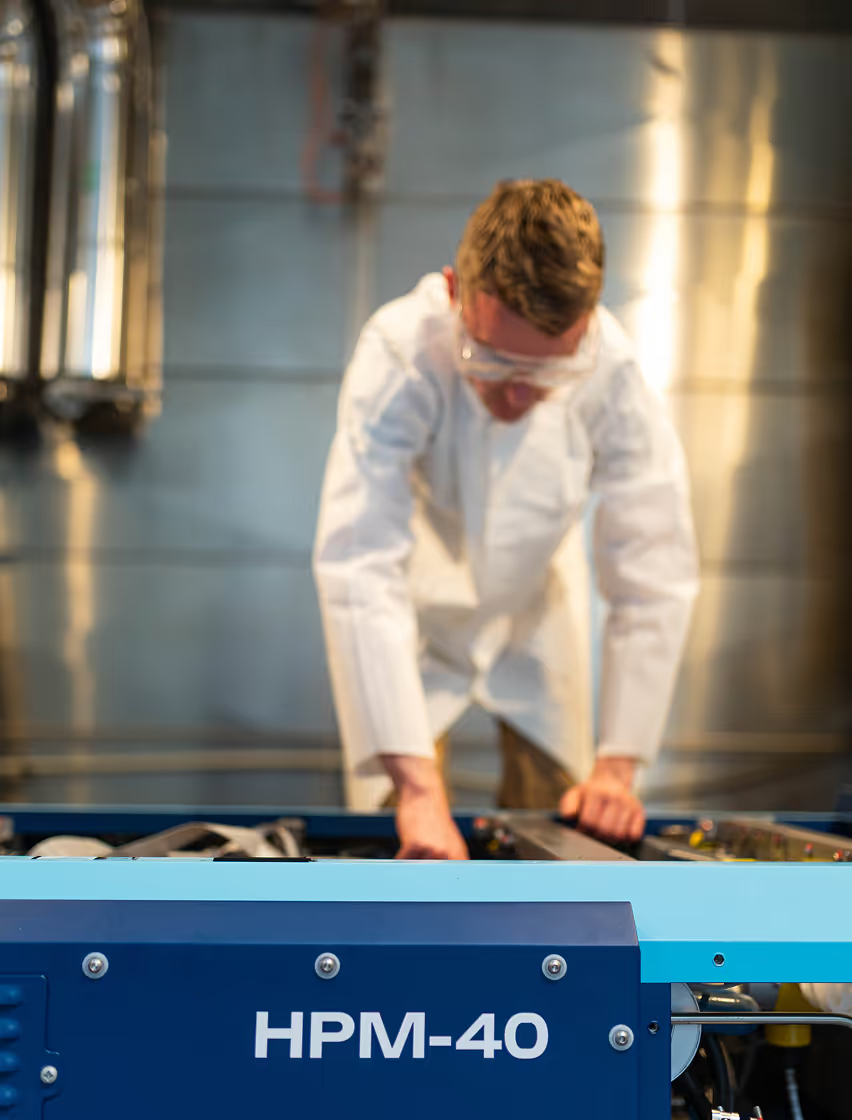
- Small vessels: 30–200 kW (HPM-40)
- Medium vessels: 250–multi MW (HPM-250)
- Large ships: 500 kW–several MW (XPM-100)
Modules can be stacked or combined to match vessel power requirements.
What fuels do our systems use?
What is the expected lifecycle and maintenance?
- PEM: 20,000–40,000 operating hours; minimal routine maintenance
- SOFC: 40,000–80,000 operating hours; low degradation rates
We provide full service, remote monitoring, and scheduled maintenance programs to maximize uptime.
What about cost and return on investment (ROI)?
While fuel cells have a higher upfront cost than conventional engines, they offer:
- Lower fuel consumption over time
- Reduced emissions penalties and taxes
- Potential eligibility for government grants or green incentives
Our team works with operators to model ROI and demonstrate financial and environmental benefits.
How do fuel cells integrate with hybrid or electric propulsion?
Fuel cells can be used:
- As primary propulsion
- As a range extender for batteries
- To power hotel loads and onboard systems
Integration is seamless with vessel energy management systems, improving efficiency and reliability.
How do I get started with a fuel cell for my vessel?
- Contact our team with your vessel specifications and operational profile.
- We provide a custom feasibility study and integration plan.
- Once approved, we handle engineering, installation, and commissioning.
- International and regional regulations are tightening to cut greenhouse-gas emissions from shipping. The IMO’s GHG strategy, measures like the EEXI, CII, and the EU’s FuelEU Maritime and EU ETS are pushing shipowners to improve efficiency, switch fuels, and reduce emissions.
- Rapid improvements in fuel-cell efficiency, durability, power density, and zero local pollutants (NOₓ, SOₓ, PM), combined with progress in low carbon fuel production (such as LNG as a transition fuel, methanol, ammonia, hydrogen, and biofuels), storage, and bunkering, are making fuel cells increasingly viable for maritime applications. Falling costs and successful pilot projects are accelerating confidence in scaling these systems.
- Rising fuel costs, carbon pricing, investor expectations, cargo-owner demands, and ESG requirements are creating financial incentives to decarbonise. Charterers increasingly prefer low-emission vessels, and access to finance is often linked to emissions performance.
How PEM fuel cells work
- Hydrogen in: Hydrogen gas is fed to the anode (negative side) of the fuel cell.
- Splitting hydrogen: At the anode, a catalyst splits hydrogen into protons (H⁺) and electrons (e⁻).
- Electricity generation: The electrons cannot pass through the membrane, so they flow through an external circuit, creating electric current. The protons pass through the proton exchange membrane to the other side.
- Oxygen in: Oxygen (usually from air) is fed to the cathode (positive side).
- Water and heat out: At the cathode, oxygen combines with the protons and electrons to form water, releasing heat.
- Result: Hydrogen + oxygen → electricity + water + heat